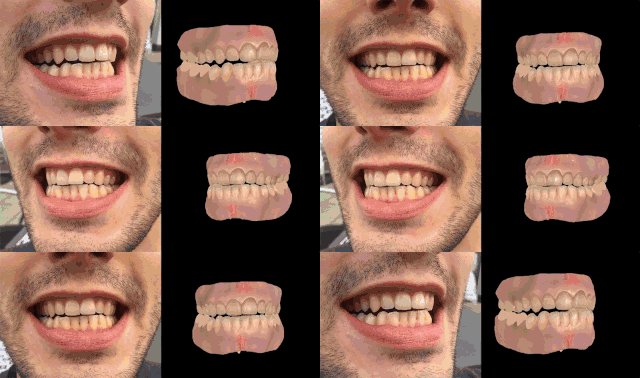
Dentures are dental prostheses are designed to re-establish lost biological mechanisms of the teeth (chewing, crunching or tearing food) that are reduced because they are no longer present. For this reason, dentures are more commonly associated with older demographics who have lost their teeth with age. The design and engineering behind dentures must mimic the oral capacities that humans have evolved over time, including the elaborate process of omnivorous mastication whereby the upper and lower jaw interconnect and align in relation to the rest of the skull to enable the mechanical break-down of food in the mouth. Often dentures are never quite as effective as biological teeth and though such prostheses have been repeatedly manufactured and revised over time, their design is yet to adequately replaced by normal teeth. The evolution of human dentition has also shaped, and been shaped by, our ability to speak and create vocalised sounds, including the capacity for language.
Prostheses are not simply artificial replacements or passive additions to the body, they are ‘extra-somatic’ extremities that articulate the confrontation between the personal body and technology and transform the way we sensorially engage with our surroundings. Ansar (2016) demonstrates that prostheses of the body have simultaneously bridged the gap and been the gap between ‘human and nonhuman, abled and disabled’, mortal and superhuman, and precisely for this reason, prostheses exist as materials that disturb the relationship between technology, the body and ideology. As such, prostheses are socio-technical objects with the capacity to eclipse the very limits of what the body can do. That is, prosthesis, in whatever form (ie. dentures, limbs, cochlear implants) shape the identity, physical capacity, language, food consumption, audition, and psychology of users.
Furthermore, in the case of dentures, these oral prostheses are markedly unique in the sense that their relationship with the body is made vulnerable as a result of their fundamental incompatibility. Contemporary oseointegrated dentures are made from titanium as a material that the body does not naturally reject and can therefore be screwed directly into oral tissue, thereby avoiding embarassing accidents like this happening:

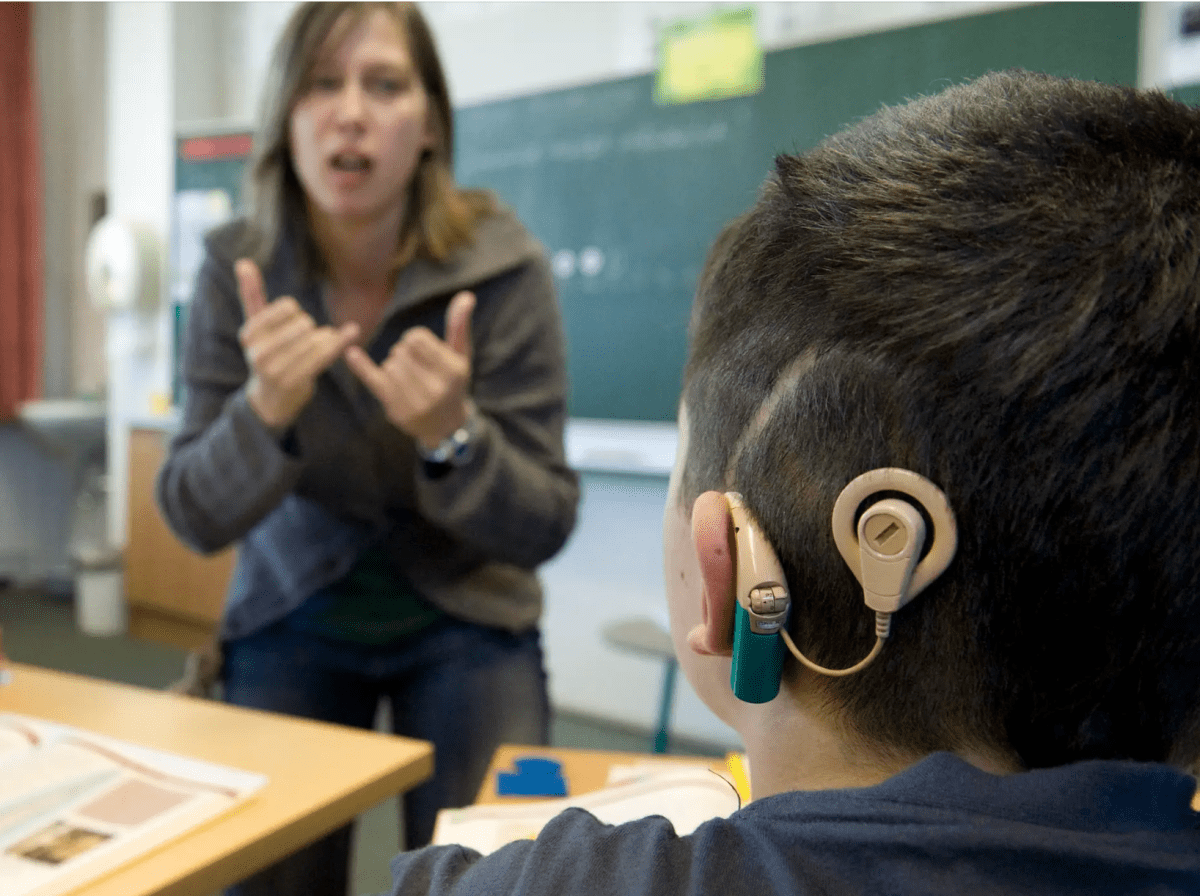
Laura Mauldin (2014) explores paediatric cochlear implantation (CI) and the clinical encounter as two processes that co-contribute to the meaning of ‘deafness’. A CI typically manifests as a surgically integrated silicon device implanted behind the ear and composed of various electrodes that channel through the ear canal and into the cochlea, the area of the inner ear responsible for the conversion of sound waves that entering the ear into electrical signals to be redirected to the auditory cortex. Cochlea implants do not ‘cure’ deafness, but they stimulate the cochlea which enable the user to detect environmental sounds.
Mauldin (2014) specifically argues that Cis are material objects that shape our understanding of deafness and those who are deaf. The CI is often discussed as a tool that the user must learn to accommodate and use, thereby offloading a significant amount of responsibility onto the user who must ‘train the brain’ to hear with the device. An inability to do so translates swiftly, albeit unjustly, into one’s inability to train their own brain. This paradox of moral ownership is unique in the case of neonates. Children recognised as deaf are labelled as such from an early age, and from this moment of a diagnosis, are subjected to particular handling and treatment within society – their learning processes are affected as a result of their lack of audition. In her book, Mauldin continues to explore the medicalisation of deafness, stating that the silence surrounding deafness and the lack of attention paid towards the deaf community is the result of cultural pressures to communicate via spoken word. The medicalisation of deafness in children is generally approached with the ultimate goal of getting them to speak out loud aided by cochlear implant prostheses, consequently suppressing the idea that sign-language could ever be a primary option, or the most appropriate option for deaf children. Indeed, this hegemony contributes to health policy changes and the nature of rehabilitation. However, as a parent of a deaf child, Mauldin (2016) also unearths an important perspective on how rooted cultural prejudices towards spoken communication problematise and complicate the role of the parents and the family dynamic.
The western contemporary attitude towards deafness is contextually situated in a current climate in which the body is understood to be constantly coming into being. CIs are therefore developed and advertised in such a way that capitalizes on the plasticity of the brain, particularly in children. Mauldin argues that during the patient-practitioner interaction, the mother often assumes the responsibility of the mediator – between her child and the doctor.
Consequently, Mauldin highlights the gendered orientation of the clinical encounter as the mother is challenged with assuming the moral high ground and making healthcare choices on behalf of her child. Supporting this notion, Ginsburg and Rapp (2001) explore how the family is the most important social centre in which the concept of disability is established and can be re-articulated. Furthermore, the way in which CIs generate meaning is dependent on the relationship between mother and child and how the parent encourages the child to deal with their deafness.
Hearing impairment is one of the most common disabilities as approximately 466 million adults and children around the world are expected to be diagnosed with impaired hearing – having a hearing capacity of 40dB or less in adults, and 30dB or less in children (WHO, 2020). A study conducted in Shiraz, Iran by Mostafavi et al (2017) investigated the obstacles faced by parents of young hearing-impaired children learning to use a cochlear implant, with a view to improving family-based interventions.
16 mothers and fathers with hearing-impaired children (diagnosis confirmed within 12 months) between the ages of two and seven took part in this phenomenological study. All completed in-depth interviews related to their child’s ability.
Recurring themes from the interviews were condensed into five main ‘clusters’, including: a need for access to health care, psychological needs, emotional needs in children, rehabilitation needs and money-related needs. All of the clusters discussed in interviews can be specialised into domains of support. Expressed worries about ‘access to healthcare’ included general concerns surrounding a lack of facilities or implants available to them. Concerns for psychological support included discussion around reduced self-esteem, anxiety, resiliency, stress levels and pessimism. These concerns also extended to emotional concerns for the child including behavioural issues or disturbed sleep cycles. Many parents reported a general lack of information or understanding about deafness and explained feeling largely unequipped to deal with hearing-related issues faced by their children. Finally, all parents discussed financial fears related to the unaffordable costs of clinical services or treatment, rehabilitation or supplementary support. Many parents discussed having to apply for financial loans and associated feelings of helplessness.
Overall, Mostafavi et al (2017) concluded that guardians of children with rehabilitating with cochlear implants feel disadvantaged. Overall, an inability to access disability services for structural or financial reasons places excessive emotional and psychological strain on families. Furthermore, parents felt a significant sense of guilt and concern surrounding their child’s disability because, if they felt they could not provide their child with access to services and treatment while young, they would consequently be responsible for their child’s ability to thrive in society later on in life. Evidently, Mostafavi et al (2017) revealed how mothers and fathers of hearing-impaired children become the mediators between their children and healthcare providers, shedding light on the socio-economic and psycho-social repercussions of this. Parent’s not only felt financially helpless in terms of gaining access to treatment or rehabilitation (many of which reported affordances such as selling their cars, houses or taking out money loans) but feared a personal inability to sustain their child’s quality of education or support them emotionally and empathetically.
Bibliography
Mauldin, L. (2013, December 13). Precarious Plasticity: Neuropolitics, Cochlear Implants, and the Redefinition of Deafness. Science, Technology, & Human Values, 39(1), 130-153.
Mauldin, L. (2016). Introduction: Medicalization, Deaf Children, and Cochlear Implants. In L. Mauldin, Made to Hear: Cochlear Implants and Raising Deaf Children (pp. 1-26). University of Minnesota Press.
Mostafavi, F., Hazavehei, S. M., Oryadi-Zanjani, M. M., Rad, G. S., Rezainanzahed, A., & Ravanyar, L. (2017, September 25). Phenomenological needs assessment of parents of children with cochlear implants. Electron Physician, 9(9), 5339-5348.
WHO. (2020, March 1). Deafness and hearing loss. Retrieved from World Health Organisation: https://www.who.int/en/news-room/fact-sheets/detail/deafness-and-hearing-loss
(featured image by Eckehard Schulz)
 Site Title