The issues raised in this blog concern the ways in which the use, function, agency, of the prosthesis can be explored in relation to the human body to which it is an appendage. A prosthesis is often referred to as an artificial appendage that occupies the position of a removed or absent anatomical limb (Jefferies 2015) or functions as an extension of the body. This blog will explore the prosthetic body in various dimensions whilst touching on matters of identity and personhood in relation to the aesthetic quality of cosmetic presentation, proprioception, and ‘able-ness’ .
Blog Post 1 – Problematising ‘normativity’ – The active appendage and overcoming self-disgust
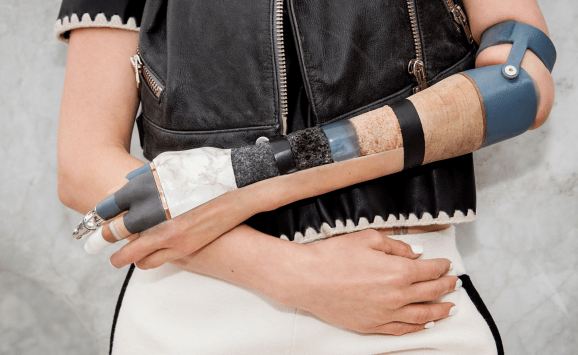
‘These hands don’t even pretend to look like normal hands… and kids love them for this reason’.
Here’s a link to Sophie’s talk:
Technological theorisations of the human body advocate its complex nature to the extent that an amputated body in rehabilitation with a prosthesis indexes the moment of encounter between human and machine (Burden et al., 2018). Before looking at contemporary theorisations of the machine-as-body, here is an except from a person essay entitled “The Mill Boy and the Hook” which was published into the Spokane Press newspaper in 1910:

This piece focuses on how early conceptions of the ‘normal’ body were distinctly shaped to fit suit capitalist modes of production. Late 19th century designs of artificial limbs were developed to enable amputees and congenially limbless people to continue working in a workhouse environment – the hook-style wrist appendage ‘hand’ as a practical provision not for the user, but to ensure the efficiency of the workhouse and to sustain the economic outcome of industry. The descriptive outline above of the hooked articulation advertises the screw-on appendage as a material index of the capitalist exploitation of workers and how the pressures of an economy driven society have resulted in the physical manipulation of the human body as means to harvest financial gains.
This novelty image of the hooked hand appendage entered Charles Dickens’ character ‘Captain Cuttle’ from Dombey and Son (1848) as a rotund middle-aged captain and literary clown who is first described in Chapter 4 as:
‘a gentleman in a wide suit of blue, with a hook instead of a hand attached to his right wrist; very bushy black eyebrows; and a thick stick in his left hand…’ (p.34)

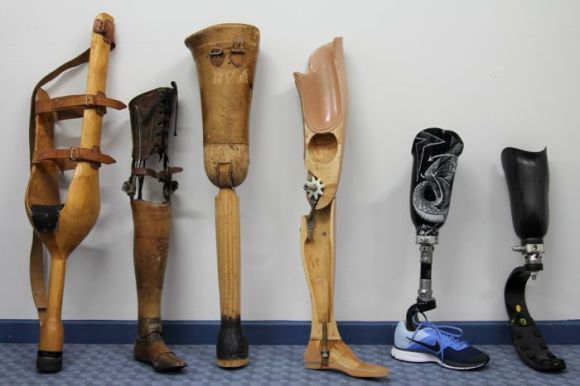
Alternative prostheses available at the time were limited to static and unmoving porcelain casts or wooden screw-on appendages. Therefore Captain Cuttle is now a historical symbol representing the most practical of Victorian prosthetics.
These prostheses are, first and foremost, an immediate product of human innovation that, through design, intention and manufacture, function to stabilise the human body. In and of themselves, bodies are socially and historically determined, and equipped with a specific spatial and physical knowledge of itself that allows it to sensorially adapt to the space it occupies at any time.
Contemporary reflections on rehabilitation with prosthetic limbs posit that such limbs are not merely passive appendages at the mercy of the user (Nelson and Wright 2001). Once fitted, an undefined and emerging relationship between the user and the limb itself commences – a process through which users slowly re-cultivates a renewed sense of body image. Burden et al., (2018) explore the way in which attempts to ‘normalise’ the amputated body with a prosthetic limb is a highly stigmatised endeavour that correlates with an increased state of self-hatred in the amputee. This is referred to as the ‘normalising’ body hypothesis – that ‘self-disgust’ is a potent schema impacting on how people cultivate body image and the type of relationship that they have with their sense of self.
It is argued that disgust is a schema closely related to body image to the extent that amputees who have experienced limb loss also experience a shrinking sense of self-worth. A study was conducted amongst lower-limb amputees sourced from a self-selected community sample of people (Burden et al 2018), revealing that as amputees learnt to use their prosthesis and became accustomed to them in relation to their bodies, the prosthesis it became ‘normalised’ and their self-disgust lessened. This analysis demonstrates how prostheses ought to be considered beyond the mechanistic function they provide. Prostheses have a significant impact on the behaviour and emotional status of the user. Furthermore, many participants reported that their prosthesis allowed them to feel and appear anatomically complete, and overcome their sense of self-disgust, ultimately motivating them to continue using their prosthesis and continue rehabilitation. Artificial limbs have the potential to enhance the psychological well-being of amputees and their bodies’ ‘affective orientation’ because it enables amputees to feel ‘whole’ and ‘normal’.
Whilst artificial limbs evidently mask the major underlying tension between technology and society, women have reported the ways in which their prostheses function as the material means to challenge strict gender binaries dividing male and female in the process of reclaiming one’s identity. Consequently, it becomes possible to understand how prostheses simultaneously pave the way for, the possibility of a plurality of bodies or the decompartmentalization of the individual body (Flanagan and Booth).
To consider prostheses as merely external appendages adorning the body is to underestimate the power of embodiment – a concept latent within western understandings bound by dualisms with which to structure relationships between mind/body, nature/culture and technology/society. Embodiment is a process eloquently described by Sobchack (2010) – an amputee who argues that artificial limbs, though visibly inorganic, can be more vividly embodied and ‘dynamically situated’ (pg.27) than a biological limb. Rather than merely focusing on the amputee and their use of the prosthesis, Holt and Murray (2019) begin with the design and function of the prosthesis itself as an object born directly out of the anatomical details and physical engineering of the biological body. Theorising the intersection between technology and and the body is a process with the potential to unearth the engineering and design of the human body which can be translated into mathematical data or models that reveal the bio-mechanical intricacies of body action and movement and the transfer of force through bone and muscle in response to the varying degrees of exercise and endurance.
Alison Landsberg (2004) investigates the meaning of prosthetic limbs through metaphor. She specifically alludes to the way in which prostheses generate the possibility for mutuality, empathy and interconnectedness and provide the opportunity to actively engage in the lives of ‘the other’. Watching an amputee use a prosthesis forces one to think about their own mobility, how we move in space and focus on the manner in which prostheses function as material outcomes of how we engage physically with space. Prostheses hyperbolise and exaggerate simple interactions and make visible the otherwise invisible ways in which people relate to their bodies and the world around them. In this way, Landsberg (2004) seeks to reveal how prostheses occupy conceptual and phenomenological realms that exist beyond binary frameworks that situate them passively and in opposition to the active body.
Bibliography
Burden, N., Simpson, J., Murray, C., Overton, P. G., & Powell, P. A. (2017). Prosthesis use is associated with reduced physical self-disgust in limb amputees. Elsevier, 109-117.
Flanagan, Mary, and Austin Booth, eds. 2002. Reload: Rethinking Women -f- Cyberculture. Cambridge, Mass.: MIT Press.
Jefferies, Philip. 2015. ‘Just Normal’: A Grounded Theory of Prosthesis Use. PhD Thesis, School of Nursing & Human Sciences, Dublin City University
Landsberg, Alison. Prosthetic memory: the transformation of American remembrance in the age of mass culture. New York: Columbia University Press, 2004.
Sobchack, V. 2010. “Living a ‘phantom limb’: on the phenomenology of bodily integrity.” Body and Society 16 (3): 51-56.
Nelson, D. M. (2001). Stumped Identities: Body Image, Bodies Politic, and the Mujer Maya as Prosthetic. Cultural Anthropology, 314-353.
Wright, M. (2001). Desire and the Prosthetics of Supervision: A Case of Maquiladora Flexibility. Cultural Anthropology, 354-373.
 Site Title