
The following blog post will explore the gendered dimensions of disability and the gendered aspects of rehabilitation with of prostheses (prosthetic limbs, knitted breasts). I will also explore how our relationship with male condoms as sexual prostheses during intercourse shape our attitude towards intimacy.
Bodies are defined and articulated in relation to the context they are in (Jain 1990) to the extent that bodies both occupy and are occupied by, the environment. Such an interaction with the day-to-day environment is precisely what Marx would argue enables concepts and ideas to become tangible, relatable and lived; the physical evidence of our humanity. Of relevance to this material approach is the process of corporeally ‘accepting’ a prosthetic limb and learning to walk. According to this framework of understanding, the prosthesis can be theorised as the material means with which one physically and spatially re-instates themselves in the world.
The prosthesis is commonly theorised according to the extent to which an amputee can fully ‘restore’ their body. Jain (1999) argues that the artificial limb is a discursive framework and social agent in its own right that can be used to explore broader questions about the ‘disabled’ body in an otherwise ‘able-bodied’ world. Beyond a phenomenological theorisation of the body in the world exists an emerging realm of inquiry seeking to understanding how and where disability is situated within the body, and who exactly the prosthesis is designed to satisfy. Rehabilitation requires an interrogation of positionally – who is being targeted, effected or involved in the process of prostheticisation? Is the arduous process of rehabilitation endured to medicate ‘ableist’ narratives and the Western medical gaze? or is it to fulfil the desires of the user? Arguably, the two are indecipherable. What are the gendered, religious, ethnic, financial, political and material repercussions of this?
Booher (2010) explores the gendered consequences of rehabilitation, looking specifically to womens’ experience adapting to a prosthetic limb. Specifically, she describes the way in which the prostheticised female body is represented as superficially ‘docile’ on popular media platforms as the epitome of social governance and control. Celebrities with prostheses are venerated as ‘supercrips’ – those who, despite their loss of limb or disability, achieve unprecedented triumphs. Whilst some may argue that the depiction of ‘supercrips’ in mainstream media marks an effort to ‘normalise’ the disabled body in the public eye, Booher refutes this arguing that, instead of celebrating difference, such depictions of supercrips in fact celebrate the merits of disabled bodies that successfully imitate a ‘normal’ body, thereby reinforcing the binary between able and disabled. Such a notion is broadly explored through the Foucauldian idea (1977) that the body is separable from the ‘social body’ and alienated within a pedagogy and thereby comparable to the unachievable, yet ever so desirable standard of a ‘normal’ functioning body. Therefore, supercrips are seemingly remarkable in the public eye because they are ‘broken’ bodies with the potential to perform at the level of the ‘complete’ body (Booher 2010, 75) and have, therefore, complied as the society intended. Furthermore, the expectations imposed on prosthetic bodies as discussed above, demonstrates the convergence between concepts of the ‘normative body’ and gender. Despite the initial disorientation of loosing a limb, amputees are expected to aspire to rehabilitate themselves to the standard of the normative able-body we are all so familiar with. This is what Scheper-Hughes (1987) might describe as womens’ bodies being monitored and surveilled by Western medical and technological conventions of the ‘the body politic’ that collectively strive to mask difference and cosmetically blur the line between the end of an amputee’s stump and the beginning of the artifice.
‘Knitted Knockers’
Watch this video below to find out more about ‘Knitted Knockers’ – a nationwide US non-profit organisation.
This group of volunteers gather together to knit prosthetic breasts for women who are suffering breast cancer or have recently recovered from a mastectomy. Unlike silicon breast prostheses that are expensive and uncomfortable, these knitted breasts are designed to prioritise comfort, affordability and practicality as they are light-weight, soft and only $2 per breast. The company ‘Knitted Knockers’ provides free instructions to anyone looking to volunteer and video tutorials which are available on YouTube. The women behind this initiative sought to bring a renewed sense of confidence to women suffering from, or recovering from breast cancer – many of whom also experience hair loss and reduced self-esteem.
These knitted breast prosthetics, specifically designed for women are officially adopted and recommended by over 1,491 medical clinics across the US. Of March 2020, an estimated 181,462 knitted prostheses have been provided by volunteers of the organisation.
‘Knitted Knockers’ was started by founder, Barbara Demorest who survived breast cancer in 2011 following a mastectomy. Though she was eager to return to work appearing ‘normal’ after her surgery, Barbara was advised not to disturb the repairing scars on her chest with a silicon breast prosthesis. As a consequence of her own personal encounter with breast cancer, Barbara developed the idea of knitting a ‘stuffable’ prosthetic alternative. That teams of volunteers across the US are working together to produce personalised gendered prostheses for cancer-survivors demonstrates an act of solidarity pursued to provide women with the means to reclaim defining outward markers of their femininity. By wearing these knitted prosthetic breasts, women can reclaim a state of normalcy in their lives and locate themselves alongside other women.
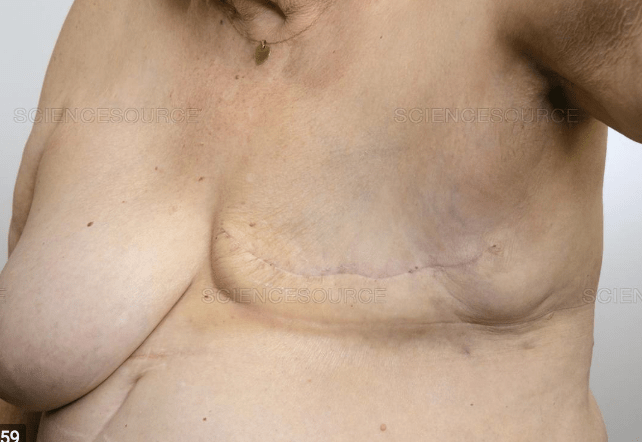
Another study by Koçan & Gürsoy (2016) focused on how a mastectomy can impact on the body image of female cancer survivors. Through semi-structured interviews with 20 participants, the results found 4 reoccurring themes including: the meaning of the breast, patient experience with mastectomy, body image changes and sociality. Most women in the study reported that breasts indexed femininity, attractiveness and being a mother, many went so far as to say that without their breasts they felt incomplete in both their bodies and in their sexual relationships with others. These findings are also supported by Davies et al., (2017) who discovered that a mastectomy can cause long-term emotional strain in the lives of patients that is not taken seriously by health care providers. Overall, Koçan & Gürsoy (2016) discovered the potential damage to identity, body image and self-esteem that many women face post-mastectomy, not to mention the real impact of loosing ones breast on mental health. One participant explained her experience seeing her scars in the mirror for the first time after the operation:
“I didn’t want to see the operation area at all; I saw it when I was back home. Before seeing it, I knew that I was going to feel the emptiness but when I saw it, I felt very different (crying), words are never enough to explain”
There has been a growing interest in the phenomenology of the amputated body over recent decades, particularly with respect to prosthetic rehabilitation. Kurzman (2001) argues that language, as a means to explain or describe the sensation of rehabilitation with a prosthesis cannot sufficiently articulate the highly personal nature of what if feels like to learn to move a prosthesis on one’s body. Kurzman refers to the specificity and incommunicability of the proprioceptive experience of manipulating a limb in space and the steps taken over time to accepting it as a part of one’s body. Kurzman (2001) nods towards the real struggles endured by amputees trying to accommodate their newly reformed bodies post-amputation, including the arduous and unnatural sensation of re-learning to walk albiet half-way through their adult lives. Therefore, Kurzman demands that amputation is a process that conjures a closer observation of body gestures and the manner in which one walks and holds themselves in space.
So, how do such adaptive processes extend to phenomenological encounters with other types of prostheses?
Eric Greene (2013) offers a ‘phenomenology of condoms’ closely observed through the brand name ‘Durex’ – a title proposing that condoms are the tough, ‘machine-like’ counter-part to our biological bodies. The man wearing the condom is implied as ‘man-as-machine’ – an ideology facilitating a state of sexual durability and pathological invincibility in the face of infection. ‘Durex’ is therefore advertised as a brand of condom to suit one’s apparently ‘superhuman’ erection. The suffix ‘-ex’ of Durex implies something distinctly robust.
With reference to the act of sex itself, Greene (2013) proposes that condoms behave as a tangible, noticeable division separating your own body from the other person to the extent that wearing one during intercourse feels awkward and, through its presence and physicality, actually reminds us of the dangers of copulation, arguably making the sex less ‘sexy’ because of the underlying sense of guilt and fear.

The presence and utility of condoms as an interruption to sex acts as a reminder of a the potential consequences of intimacy – the pause between foreplay and penetration dedicated to adorning the contraceptive, leaving room for contemplation, momentary reflection and the impending dissolution of arousal. Upon initial encounter, its clear that condoms are engineered to imitate the feeling of sex as the latex sheath is lubricated to accompany the expectations surrounding the condition of the vaginal orifice.
Deadroff (2013) investigated the sexual values and ‘condom negotiation strategies’ shared by Latino youths living in the United States. The study arrived in response to reports that young Latino men and women aged between 16-22 across the US are more at risk of contracting STIs, but are less likely to use condoms. 694 participants within that age range took part in this study and 61% were female. Deadroff (2013) uncovered that Latino’s increased exposure to STIs presents as a consequence of cultural values surrounding sexual intercourse and the gendered etiquette of sex itself. Fundamentally, participants stated that traditional cultural norms do not tolerate casual conversation about sex, even between two partners and especially not from women. Furthermore, female participants in the study articulated the importance of prioritising male sexual pleasure and deeply respected pre-marital virginity. The outcome of this research was to demonstrate why sexual health initiatives seeking to navigate issues of sexually-transmitted infections should begin by observing the condom negotiation strategies and cultural values of Latinos surrounding the performativity and gendered aspects of sex.
Another study by Crosby et al (2013) explored the gender differences related to condom perception and use. It is suggested that American men use condoms during approximately 25%, and women only 22%. Data was collated using a survey sent out through mailing list to 65,859 male and female participants over the age of 18, Crosby et al (2013) discovered that the primary excuse for not using condoms during sex was because condoms didn’t fit or were uncomfortable. More specifically, ill-fitting condoms caused reduced sensation or decreased pleasure, therefore making the sex itself feel ‘unnatural’ or even uncomfortable.
Overall, by understanding the phenomenology of condoms as prostheses, it is possible to observe the various ways in which people have in response to, and around condoms as artificial implements so critical, not merely in terms of controlling the population and the spread of sexually transmitted infections, but in the physical, social and cultural act of sex itself. What does it mean to use a condom, or perhaps, more crucially, what does it mean to not use a condom? How is barrier contraception not simply an individual decision but a collective choice? Beyond the prevention of pregnancy, how do condoms as material intersections in our sexual lives influence how we approach sexual intercourse? What are the gendered implications of using condoms and where should we (0r can we) successfully locate condoms in accordance with cultural, religious and social values attached to sexual relationships.
Bibliography
Booher, A. K. (2010, September). Docile bodies, supercrips, and the plays of prosthetics. International Journal of Feminist Approaches to Bioethics, 3(2), 63-89.
Crosby, R. A., Milhausen, R. R., Mark, K.P., Yarber, W. L ., Sanders, S. A., & Graham, C. A. (2013). Understanding Problems with Condom Fit and Feel: An Important Opportunity for Improving Clinic-Based Safer Sex Programs. New York: Springer.
Davies, C., Brockopp, D., Moe, K., Wheeler, P., & Abner, J. (2017). Exploring the Lived Experience of Women Immediately Following Mastectomy: A Phenomenological Study. Cancer Nursing, 40(5), 261-368.
Deadroff, J., Tschann, J. M., & Flores, E. (2013, December). Latino Youths’ Sexual Values and Condom Negotiation Strategies. Perspectives on Sexual and Reproductive Health, 45 (4), 182-190.
Foucault, Michel 1977 Discipline and Punish: The Birth of the Prison. Alan Sheridan, trans. New York: Random House.
Greene, E. (2013, July). The Phenomenology of Condoms. 13(2), 113.
Jain, S. S. (1999). The Prosthetic Imagination: Enabling and Disabling the Prosthesis Trope. Science, Technology, & Human Values, 31-54.
Koçan, S., & Gürsoy, A. (2016, October). Body Image of Women with Breast Cancer After Mastectomy: A Qualitative Research. J Breast Health, 12(4), 145-150.
Scheper-Hughes, N., & Lock, M. M. (1987, March). The Mindful Body: A Prolegomenon to Future Work in Medical Anthropology. Medical Anthropology Quarterly, 1(1), 6-41.
 Site Title